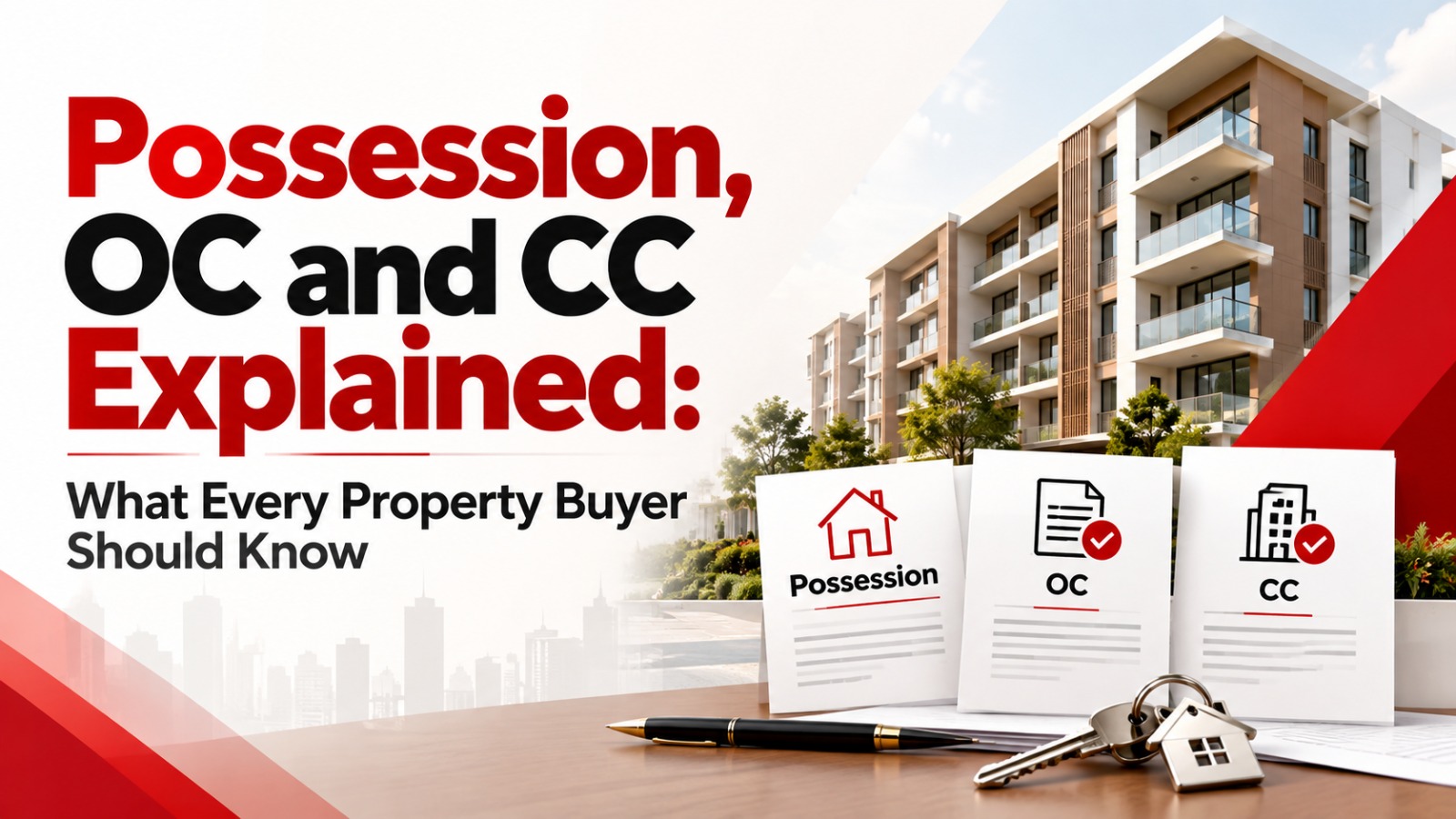
The last stage of buying a new home is where paperwork matters most. The developer sends an “offer of possession”, asks for the final payment, and refers to documents called the OC and the CC. Many buyers accept the keys without fully understanding what these documents are, or why they matter.
This guide explains possession, the Occupancy Certificate (OC) and the Completion Certificate (CC) in plain language. It covers what each one means, how they differ, why you should not skip them, and how to check them before you take possession.
Quick Answer
| Term | What It Means in Simple Words |
| Possession | You take control of the home, and the developer hands over the keys |
| Completion Certificate (CC) | The local authority confirms the building was completed as per the approved plan |
| Occupancy Certificate (OC) | The local authority confirms the building is fit to be occupied, with basic services in place |
A note on the term “CC”: in real estate it can stand for Completion Certificate, and it can also stand for Commencement Certificate, a different document issued before construction begins. This guide uses CC for Completion Certificate and explains the Commencement Certificate separately below.
Part 1: Possession Explained
What is possession?
Possession is the point at which the developer hands the home over to you. It usually involves a written offer of possession, final payments, an inspection, and a handover of keys.
Types of possession
| Type | Meaning |
| Physical possession | You receive the keys and can enter and use the home |
| Legal possession | Ownership is transferred to you through a registered sale deed or conveyance deed |
Getting the keys does not by itself make you the legal owner. Ownership passes through the registered deed, so ask when and how it will be executed.
The usual sequence
- The developer obtains the required completion and occupancy documents from the authority.
- The developer sends an offer of possession letter, with the final demand for any balance payment.
- You inspect the home, note any defects, and raise them in writing.
- You clear the dues and sign the handover documents.
- You receive the keys and the possession letter.
- The sale deed is registered, if not already done, and you apply for mutation in municipal or revenue records.
Part 2: The Completion Certificate (CC)
What is it?
A Completion Certificate is issued by the relevant local authority after the building is completed. It confirms that construction follows the approved building plan and complies with applicable building rules. The relevant authority for a project could be a development authority such as MDDA, or another body with jurisdiction over the land.
What it usually covers
- The building has been constructed in accordance with the sanctioned plan.
- Structural and planning norms have been followed
- Required clearances, such as fire safety approval where applicable, are in place
Commencement Certificate, for comparison
A Commencement Certificate is different. It is issued before construction and allows the developer to begin building as per the approved plan. It shows the project started with permission, but it says nothing about whether the finished building is compliant.
Part 3: The Occupancy Certificate (OC)
What is it?
An Occupancy Certificate is issued by the local authority to confirm that a completed building is fit for people to live in. It generally confirms that the building meets the approved plan and that basic services such as water, sanitation, electricity and fire safety are in place.
Why it matters to a buyer
- Utility connections: electricity and water providers may ask for the OC before giving permanent connections.
- Legal use: a building occupied without the required certificate may face action from the authority.
- Home loans: lenders generally look for these documents, especially for resale and final loan disbursement.
- Resale: a buyer, lawyer or bank will usually ask for the OC when you sell.
- Insurance and claims: missing approvals can complicate them.
Partial or phase-wise OC
Large projects are often built in phases or towers. An OC can be issued for one tower or phase while others are still under construction. Check that the certificate covers the specific tower and the specific units that include your home.
Part 4: How the Documents Compare
| Document | Issued When | Issued By | What It Confirms |
| Commencement Certificate | Before construction | Local authority | Permission to start building as per the approved plan |
| Completion Certificate | After construction is complete | Local authority | The building matches the approved plan and norms |
| Occupancy Certificate | After completion and inspection | Local authority | The building is fit for occupation with services in place |
In some states and authorities, the completion and occupancy certificates are separate documents. In others, one document serves both purposes or the names are used differently. Ask the developer which document was issued in your project, and ask a lawyer to confirm it is the one required locally.
Part 5: What RERA Says About These Documents
RERA sets obligations for developers of registered projects. In general terms:
- The developer must obtain the completion or occupancy certificate from the competent authority and make it available to buyers or the buyers’ association.
- The agreement for sale should state the possession date, and RERA provides remedies for delay, such as interest or refund, as per the law and the agreement.
- Registered conveyance of the property and handing over of documents and common areas are part of the developer’s responsibilities after the certificate is issued.
- A defect liability period applies after possession, during which structural or workmanship defects reported by the buyer are to be rectified by the developer, as set out in the law.
The exact timelines and conditions are set by the Act, state rules and your agreement, so ask your lawyer how they apply to your purchase.
Part 6: How to Verify the Certificates Before Possession
- Ask for copies of the completion and occupancy certificates well before you accept possession.
- Check the basic details: project name, address, tower or block, floors covered and the issuing authority should match your agreement.
- Check the date and any conditions: some certificates come with conditions that need to be met later.
- Match them with the approved plan: the certificate should refer to the sanctioned plan for the building.
- Check the RERA portal: many projects upload approvals and updates there. Compare what is shown with what you are given.
- Ask about fire and other clearances, where applicable to the building.
- Have a lawyer review the documents, especially if the certificate is partial, conditional or described as “applied for”.
If the developer says the certificate is “applied for” or “in process”, ask for a written timeline and a copy of the application. Consider delaying acceptance of possession until the certificate is issued, after taking legal advice.
Part 7: Possession Day Checklist
Documents to receive or verify
- Copy of the Occupancy Certificate and Completion Certificate
- Offer of possession letter and final statement of account
- No-dues certificate or payment confirmation from the developer
- Possession letter and handover record
- Approved floor plan and, where provided, as-built details
- Maintenance agreement and details of who collects charges
- Details of warranties and the defect liability period
- Utility connection details and meter information
Inspection points
- Compare the unit with the agreed specifications
- Check walls, ceilings, flooring and paintwork
- Test taps, drains, switches, lights and fans
- Check doors, windows, balcony railings and locks
- Look for damp patches, leaks or seepage
- Check that lifts, parking and common areas are functional
Steps at handover
- List every defect in writing, and ask for a fix within a set time.
- Read every form before signing. Be careful with any declaration that says you are fully satisfied or that waives your rights, including rights related to delay or defects, and ask a lawyer to review it if unclear.
- Note the meter readings, and take dated photos of the condition of the home.
- Keep copies of everything you sign.
Part 8: What Happens After Possession
- Registration and mutation: complete the registered deed if it is not done, and update ownership in municipal or revenue records.
- Utilities: apply for or transfer electricity and water connections.
- Property tax: register and pay on time.
- Association: register with the resident association or facility manager.
- Maintenance: confirm charges and payment schedule.
- Defect reporting: report defects in writing within the defect liability period, and keep a record.
- Document folder: store all originals safely, with scanned copies stored separately.
Part 9: If Possession Is Delayed or the Certificates Are Missing
- Check your agreement: look at the promised possession date and the terms for delay.
- Ask for the reason and a written timeline for obtaining the certificates.
- Keep records: save letters, emails, receipts and messages.
- Seek legal advice: a lawyer can explain your options under RERA and your agreement.
- Avoid moving in without the required certificate unless you have taken legal advice, since it can affect utility connections, loans and resale.
- Approach the regulator if needed: for registered projects, buyers can file complaints with the state real estate regulatory authority.
Part 10: Buying a Ready or Resale Home
Ask the seller for the OC and CC before you pay a token amount.
- Ask for the completion and occupancy documents along with the sale deed and approved plan.
- Check that the built area, number of floors and use match what the certificate approves.
- Check for unauthorised additions, such as extra floors or enclosed balconies, that are not in the approved plan.
- Ask for property tax receipts, utility bills and a society no-dues certificate.
- Ask your lawyer to review the papers before you commit.
Warning Signs
- The developer cannot show the OC or CC, or describes it as “in process” with no written timeline.
- The certificate details do not match the project, tower or address.
- Pressure to take possession and pay the final amount before documents are shared.
- Requests to sign a full-satisfaction declaration before you have inspected the home.
- Differences between the approved plan and the constructed home.
- Reluctance to let your lawyer review the certificates.
Common Mistakes Buyers Make
- Treating the keys as the transfer of ownership
- Accepting possession without seeing the OC
- Confusing a Commencement Certificate with a Completion Certificate
- Signing handover forms without reading them
- Not listing defects in writing
- Delaying registration and mutation
- Not keeping copies of documents
About GTM Group
GTM Group is a real estate developer with residential projects in Dehradun. Its projects include GTM The Capital on Sahastradhara Road, near Doon IT Park and the IIE area, and GTM Forest & Hills on NH-72, Haridwar Road. Approval and certificate status can differ by project, phase and tower, so ask the sales team for the current status of the specific project you are considering.
You can read more about GTM The Capital apartments in Dehradun, or contact the sales team at sales@gtm.co.in or +91 9910475296 for an enquiry. For more information, read our homebuyer’s guide to RERA, registry and property documents blog.
Frequently Asked Questions
What is the difference between OC and CC?
A Completion Certificate confirms that the building was built as per the approved plan. An Occupancy Certificate confirms that the building is fit for people to live in, with basic services in place. In some places one document covers both.
Is the Occupancy Certificate mandatory?
Local building rules generally require it before a building is occupied. Ask a lawyer how the requirement applies in your area.
Can I take possession without an OC?
It may be possible in practice, but it can cause problems with utility connections, home loans, insurance and resale. Take legal advice before accepting possession without one.
What is a Commencement Certificate?
It is a permission issued before construction that allows the developer to start building as per the approved plan. It is different from a Completion Certificate.
Does possession mean I am the legal owner?
Not by itself. Legal ownership passes through the registered sale deed or conveyance deed.
Where can I check whether the certificates are genuine?
Check the details against your agreement and the project’s RERA page, and ask your lawyer to verify the certificate with the issuing authority.
What if my flat is different from the approved plan?
Note the differences in writing and raise them with the developer before accepting possession. Ask your lawyer how the agreement and the law apply.
How long does the developer have to fix defects after possession?
RERA sets a defect liability period after possession for registered projects, and your agreement may also address it. Ask your lawyer for the exact period that applies to you.
Conclusion
Possession, OC and CC are connected but separate. Possession is the handover of the home. The Completion Certificate confirms that the building was built as approved. The Occupancy Certificate confirms that it is fit to be lived in. Ask for the certificates early, verify the details, inspect the home carefully and keep every document. A few extra days spent on checks at this stage can prevent problems with utilities, loans and resale later.
If you are considering an apartment in Dehradun, you can send an enquiry to GTM Group for project details, certificate status and site visit options.