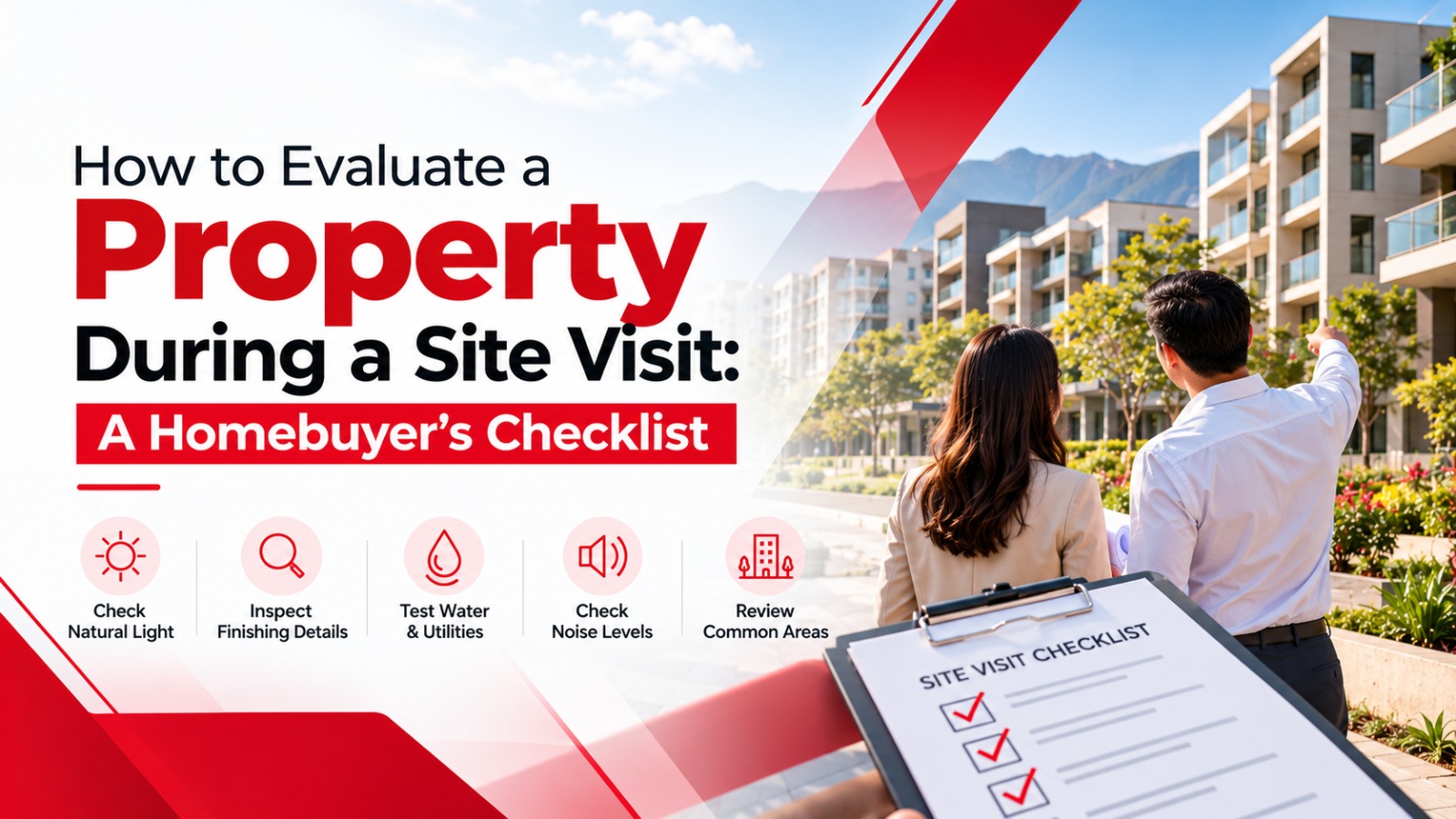
Brochures and photos show a property at its best. A site visit shows what it is actually like: the light in the rooms, the condition of the walls, the water pressure, the noise, the parking and the neighbourhood. It is also where many buyers make decisions in a hurry, without a plan.
This checklist helps you inspect a home in an organised way. It covers what to prepare, what to check inside the unit, in the building and around it, and what to ask before you leave. It includes points specific to Dehradun, such as monsoon drainage, hill terrain and seasonal light.
Before the Visit: Prepare
Decide what you are looking for
Write down your must-haves before you go, such as the number of bedrooms, floor preference, parking and budget. This keeps you from being swayed by a good presentation.
Ask for details in advance
- The exact unit or type you will be shown, and whether it is a ready home, an under-construction unit or a sample flat
- Carpet area, floor plan and price details
- RERA registration number for the project
- A contact person who can answer technical questions
Carry these items
| Item | Use |
| Measuring tape | Check room sizes against the floor plan |
| Phone torch | Look inside cupboards, meter boxes and dark corners |
| Phone charger | Test whether sockets work |
| Notebook or notes app | Record observations for each property |
| Camera or phone | Photograph defects and features for later comparison |
| Floor plan and agreement draft | Compare what you see with what is promised |
| Compass app | Check which way rooms and balconies face |
Choose the right time
- Daytime: shows natural light, views and construction quality clearly.
- Evening or peak hours: shows traffic, noise, parking pressure and lighting in the area.
- After rain, if possible: shows drainage, waterlogging and any seepage.
If you can, visit the same property more than once at different times.
Step 1: Start With the Approach and Surroundings
Your evaluation starts before you enter the building.
- Road access: check the width and condition of the approach road, and how easy it is for a car to enter and exit.
- Drainage: look for standing water, open drains and signs of waterlogging on the road and near the gate.
- Streetlights and safety: check lighting and how the area feels in the evening.
- Traffic and noise: listen for road noise, and see whether commercial activity nearby could be disturbing.
- Nearby services: note the distance to schools, hospitals, markets, pharmacies, banks and public transport.
- Neighbouring buildings: check what is around the project, and whether any construction is ongoing.
- Terrain: on sloping ground, look at retaining walls and how water flows away from the building.
Step 2: Check the Building and Common Areas
Entrance, security and parking
- Is there a gate with security staff, visitor records and CCTV?
- Are parking slots marked, and is there visitor parking?
- Is the parking area well lit, ventilated and free from waterlogging?
- Can two-wheelers and cars move in and out easily?
Lifts and staircases
- Do the lifts work smoothly, and is there power backup for them?
- Are staircases clean, well lit and wide enough?
- Are handrails secure?
Fire safety
- Are fire extinguishers visible and in date?
- Are emergency exits marked and unobstructed?
- Are there fire hydrant points, sprinklers or smoke detectors, where applicable?
- Ask to see the fire NOC where applicable to the building.
Power, water and utilities
- Ask what power backup covers, and how it is billed.
- Ask about the water source, storage tanks and supply hours.
- Look at the condition of the meter rooms, water tanks and terrace.
- Check whether rainwater drains away properly from the terrace and podium.
Common amenities
- Check which amenities are already built and functioning, and which are only planned.
- Ask who maintains them and what maintenance charges cover.
- Note the cleanliness and upkeep of common areas, since this hints at how the building will be managed.
Step 3: Inspect the Unit, Room by Room
Entrance and doors
- Do the main door and internal doors open and close smoothly?
- Are locks, latches and frames in good condition?
- Are there gaps around the frames?
Living and dining areas
- Note the natural light and how it changes with the direction of the windows.
- Check ventilation with windows and doors open and closed.
- Measure the room and compare it with the floor plan.
- Count and test the electrical points, and think about where your furniture and TV will go.
Bedrooms
- Check space for beds, wardrobes and movement.
- Look at windows, privacy and street noise.
- Test switches, fans and lights.
- Check for damp patches on walls and ceilings, especially on outer walls.
Kitchen
- Check counter space, sink position and storage.
- Turn on the taps and check water pressure and drainage.
- Look at ventilation, and space for a chimney or exhaust.
- Check gas pipeline provisions, if any, and electrical points for appliances.
Bathrooms
- Turn on all taps, the shower and flush the toilet.
- Check whether the water drains quickly, and whether the floor slopes towards the drain.
- Look for leaks under sinks and around fittings.
- Check for ventilation or an exhaust point.
- Check the waterproofing, and look for stains on ceilings of the unit below, if accessible.
Balconies and terraces
- Check railing height and stability.
- Look at the floor slope so water drains away and does not collect.
- Note the view, privacy and sun exposure.
Step 4: Look Closely at Construction Quality
Walls and ceilings
- Look for damp patches, peeling paint, bubbling plaster and stains.
- Hairline cracks in plaster can be common, but wide, diagonal or spreading cracks deserve review by a structural engineer.
- Tap walls gently, and note any hollow-sounding patches.
Floors and tiles
- Walk on the floor and look for uneven surfaces.
- Tap tiles gently. Hollow sounds may indicate poor fixing.
- Check for chipped tiles, uneven joints and gaps.
Doors and windows
- Open and close every window.
- Check that frames are straight and that locks work.
- Look for gaps that could let in rain, dust or noise.
Electrical and plumbing
- Switch on lights, fans and sockets, and use your phone charger to test a few.
- Look at the distribution board, and check that circuits are labelled.
- Turn on taps in different rooms together to see how water pressure holds up.
- Look for exposed wiring or pipes.
Ceiling height and finishing
- Check ceiling height, false ceiling provisions and paint quality.
- Look at the finishing of edges, corners, skirting and fittings.
Step 5: Check Dehradun-Specific Factors
- Monsoon: ask residents about waterlogging, seepage and leaks in the rainy season. Look at terrace drainage and the basement or parking area.
- Slope and retaining walls: on hill-facing or uneven sites, ask how the project handles slope stability and water runoff.
- Seismic zone: Dehradun lies in a high seismic zone, so ask about the structural design and approvals of the building, and let an engineer review them if you have concerns.
- Winter and summer comfort: check where the sun falls at different times of day, and whether the home gets good light in winter and airflow in summer.
- Water supply: ask whether supply is from a municipal line, borewell or tanker, and what happens in dry months.
- Power interruptions: storms can interrupt power, so ask how quickly backup starts and what it covers.
- Mobile and internet signal: test your phone signal inside the unit and in the lift and parking area, and ask which internet providers serve the building.
Step 6: Visiting an Under-Construction Project
A site visit for an unfinished project needs a different approach.
- Compare progress with the payment plan: the stage of construction should match the stage of payment you are asked to make.
- Check the RERA details: confirm the registration number matches the official portal, and note the promised completion date.
- Look at materials and workmanship: check brickwork, concrete finishing, plastering and plumbing lines where visible.
- Ask about specifications: get the list of fittings, flooring, doors and finishes in writing.
- Site safety and management: note whether the site looks organised and safe.
- Sample flat: it shows finishes and layout, but it may differ from your unit in size, orientation and view. Ask to see the actual floor or block where your unit will be.
- Ask for stage-wise photos: ask how the developer shares progress updates.
Step 7: Talk to the People There
- Security staff and housekeeping: ask how the building is managed day to day.
- Residents: in an occupied building, ask about maintenance, water, power, noise and response time for repairs.
- Resident association or facility manager: ask about dues, rules and any pending disputes.
- Neighbours outside the project: ask about traffic, waterlogging and safety in the area.
Speak to more than one person, and compare their answers.
Step 8: Ask the Right Questions Before You Leave
Price and charges
- What is the total cost, including parking, maintenance deposit and other charges?
- What is included in the maintenance charges, and can they change?
Area and layout
- What is the carpet area, built-up area and super area?
- Can I see the approved floor plan?
Possession and timeline
- When is possession, and what happens if it is delayed?
Approvals and paperwork
- What is the RERA registration number?
- Can I see the approved plan, title documents and completion or occupancy certificate, where applicable?
Payments and loan
- What is the payment plan?
- Is the project approved by banks for home loans?
Other
- Which amenities are complete, and which are pending?
- What warranty or defect-liability terms apply?
Ask for answers in writing where you can.
After the Visit: Next Steps
- Review your notes and photos the same day.
- List doubts and questions, and send them to the developer or seller in writing.
- Share the documents with your lawyer.
- Consider a second visit, at a different time of day, before you decide.
- Do not pay a booking amount until the legal and RERA checks are complete.
For a full guide to legal checks, read our homebuyer’s guide to RERA, registry and property documents.
Red Flags During a Site Visit
- The seller or developer avoids showing the actual unit or the approved plans.
- The carpet area you measure is noticeably smaller than the floor plan.
- Damp patches, fresh paint over stained areas, or a musty smell.
- Wide or spreading cracks in walls or ceilings.
- Poor water pressure or slow drains.
- Amenities described as ready that are unfinished or unused.
- Documents described as “in process” with no written timeline.
- Pressure to pay a booking amount on the spot.
- Unwillingness to let your lawyer or engineer inspect.
Common Site Visit Mistakes
- Going only once, and only at one time of day
- Relying on the sample flat
- Focusing on décor and ignoring construction quality
- Not testing taps, switches and drainage
- Skipping the neighbourhood and commute check
- Not taking photos and notes
- Deciding on the spot
About GTM Group
GTM Group is a real estate developer with residential projects in Dehradun. Its projects include GTM The Capital on Sahastradhara Road, near Doon IT Park and the IIE area, and GTM Forest & Hills on NH-72, Haridwar Road. Availability, approvals and RERA registration can differ by project and phase, so confirm them with the sales team for the specific project you plan to visit.
You can read more about GTM Forest & Hills in Dehradun, or contact the sales team at sales@gtm.co.in or +91 9910475296 to request a site visit.
Frequently Asked Questions
How long should a site visit take?
Allow at least an hour for a single unit and the common areas, and more if you are checking several properties or an under-construction project.
What time of day is best for a site visit?
Daytime shows light and construction quality, while evening shows traffic, noise and safety. If possible, visit at both times.
Should I visit during the monsoon?
If you can, yes. A visit after rain shows drainage, waterlogging and seepage that may not be visible in dry weather.
Can I bring an engineer or architect?
Yes. A professional can check the structure, finishing and services, and you can ask the developer or seller for permission to bring one.
How do I check the carpet area?
Measure the main rooms with a tape and compare the total with the floor plan. Ask for the carpet area in writing in the agreement.
Is a sample flat enough to decide?
No. A sample flat shows layout and finishes but may differ from your unit in size, orientation and view. Ask to see the actual unit or floor.
What should I do after the visit?
Review your notes, send written questions, share documents with a lawyer, and consider a second visit before you pay a booking amount.
Conclusion
A site visit works best when you go prepared, inspect the property in a set order and record what you see. Check the neighbourhood, the building, the unit and the documents, then compare properties using the same criteria. Take your time, visit more than once if needed, and put every promise in writing.
If you are considering flats in Dehradun, you can request a site visit from GTM Group to see the project in person.